Catalysis in Biological Media
Developing biocompatible Ruthenium catalysts for bio-orthogonal chemistry in aqueous media.
Chemistry vs. Biology
Synthetic chemists usually work in dry flasks under nitrogen. Biology happens in water, full of salts and "catalyst poisons". My goal is to make metal catalysts feel at home in the cell.
The Hostile Environment
Most transition metals die instantly in physiological media. Thiols (like glutathione) bind to them; water hydrolyzes them.
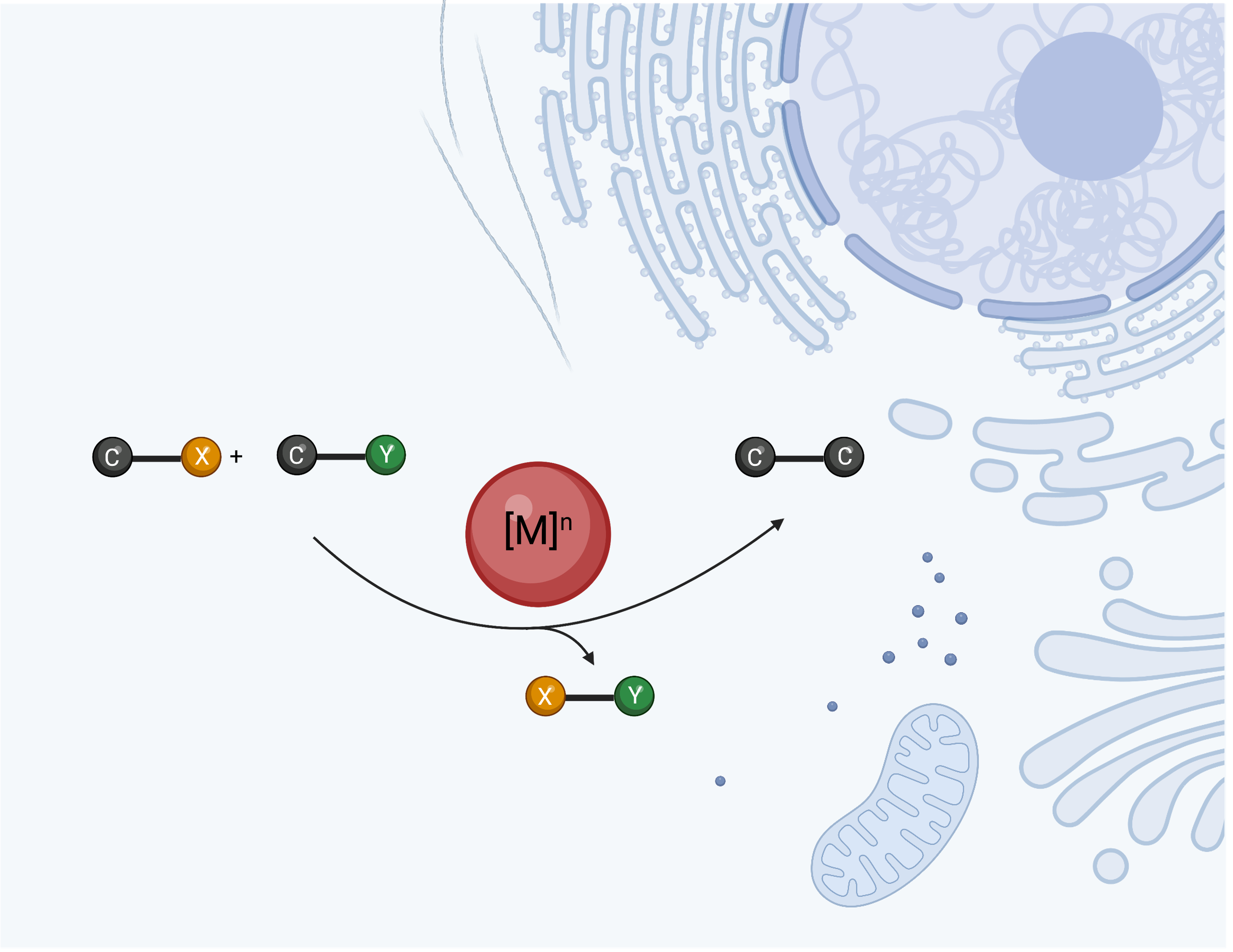
We engineered a Cationic Ruthenium System that is robust enough to ignore the noise. It catalyzes C–C bond formation (Alder-ene coupling) even in cell lysates and DMEM culture media.
Precision Labeling
Why does this matter? Because it allows us to tag specific proteins or peptides at very low concentrations.
We demonstrated the selective labeling of peptides containing reactive residues (Tyrosine, Cysteine) without side reactions. It's a new "click" reaction for the chemical biology toolbox.
